Introduction
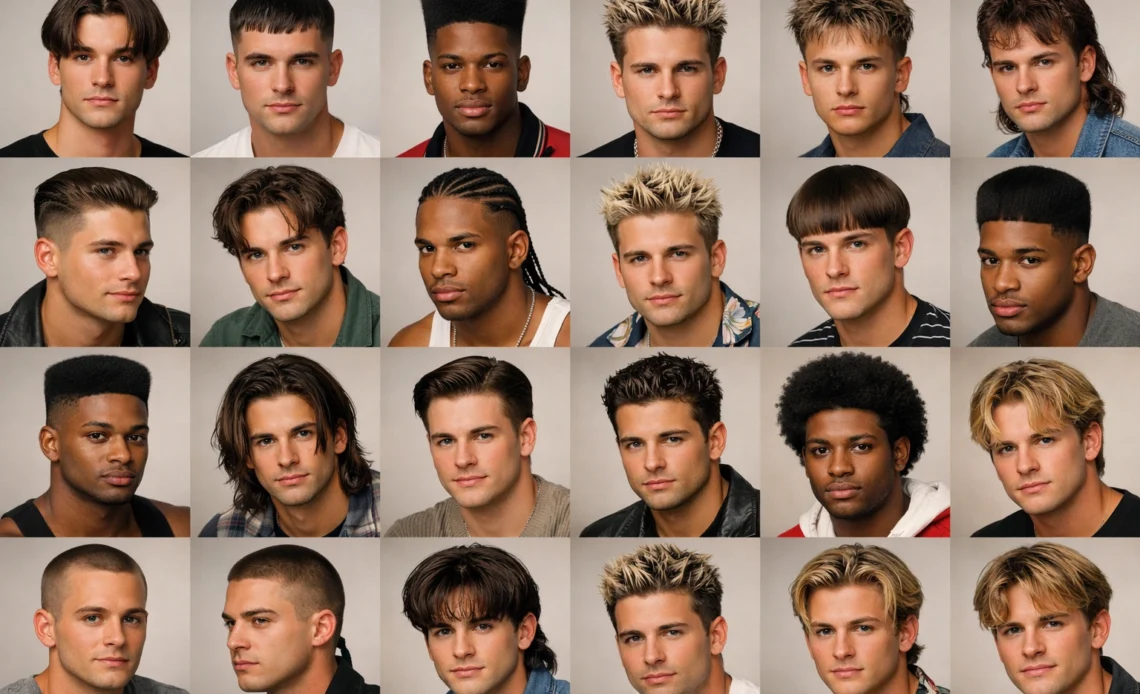
Few decades in modern history produced a more distinctive and culturally loaded catalogue of men’s hairstyles than the 1990s. It was a decade defined by contradiction: polished boy band elegance coexisting with raw grunge rebellion, Hollywood glamour running alongside streetwear authenticity, and hip-hop culture reshaping the grooming conversation for an entire generation. The haircuts that emerged from this remarkable collision of influences were not simply styles. They were statements of identity, affiliation, and attitude that told the world exactly who you were and where you stood.
Decades later, those iconic 90s haircuts for men are not merely surviving in the collective memory. They are actively returning to barbershops, runways, and social media feeds with a momentum that shows no sign of slowing. The revival of 90s grooming is not driven by nostalgia alone. It is driven by something more practical: these haircuts were built around natural texture, low-effort styling, and genuine self-expression, qualities that resonate deeply with the way modern men think about their appearance today. The curtain haircut, the Caesar cut, the high top fade, and the frosted tips that once defined a generation are being reinterpreted through contemporary barbering techniques and modern styling products to deliver results that feel both timeless and fresh.
This guide presents 20 of the most iconic 90s haircuts for men, exploring what made each one culturally significant, why it still works today, and how to wear it with the confidence and intention it deserves. Whether you are revisiting a cut you wore in your youth or discovering the era’s greatest styles for the first time, there is something in this list for every man who wants his hair to mean something.
The Curtain Haircut
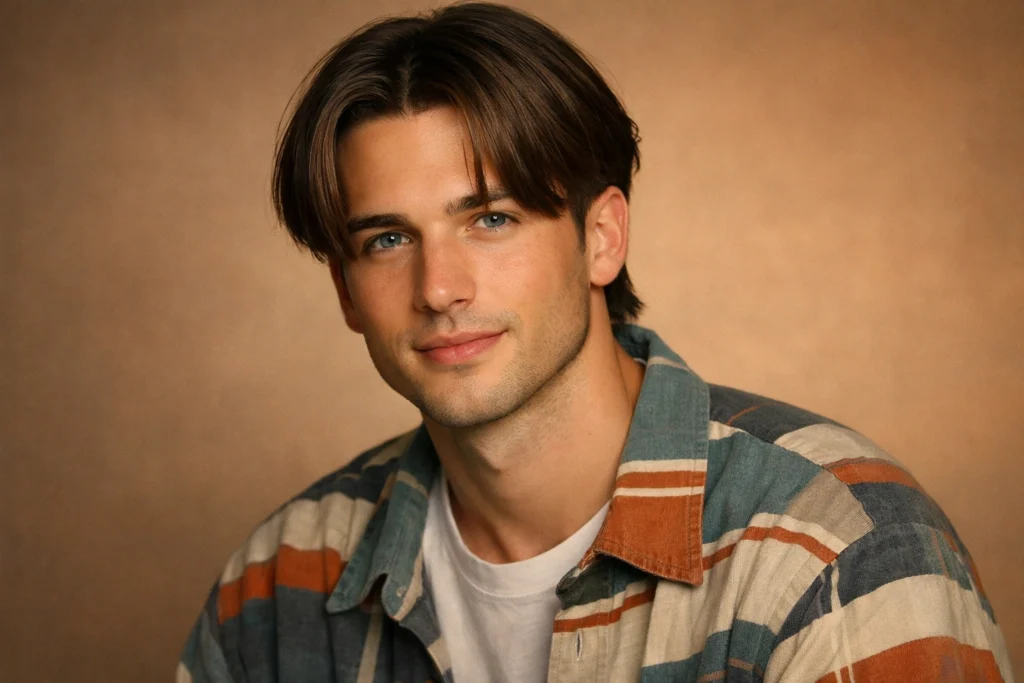
No hairstyle captures the spirit of 90s men’s grooming more completely than the curtain haircut. It defined the heartthrob aesthetic of the decade, worn by Leonardo DiCaprio, Johnny Depp, David Beckham, and Keanu Reeves with an effortless, almost accidental handsomeness that made it the most replicated style of its era. The curtain cut features longer hair on top, parted down the center or slightly off-center, with the hair falling naturally to either side of the face in the manner of parted curtains. The sides are typically shorter, either tapered or left at a medium length that allows the top’s length to read clearly.
The curtain haircut works because it frames the face with a softness that flatters most face shapes while projecting a relaxed, confident character. Its contemporary revival has updated the original with subtle modifications: a low fade or undercut on the sides creates a cleaner, more modern contrast, and a light texturizing spray or sea salt product gives the hanging sections natural movement rather than the flat, uniform fall of the original. Men with straight to wavy hair get the most natural results from this cut, though those with a slight wave find the style gains additional dimension and life. The curtain haircut is the definitive entry point for any man exploring iconic 90s haircuts for men, and it remains one of the most wearable and flattering options available at the modern barbershop.
How to Wear It Today
Part the hair down the middle while slightly damp and apply a light styling cream or mousse. Let it air dry for the most natural result, or use a diffuser for additional volume. Ask your barber for a low fade or taper on the sides to modernize the silhouette while preserving the signature curtain effect on top.
The Caesar Cut
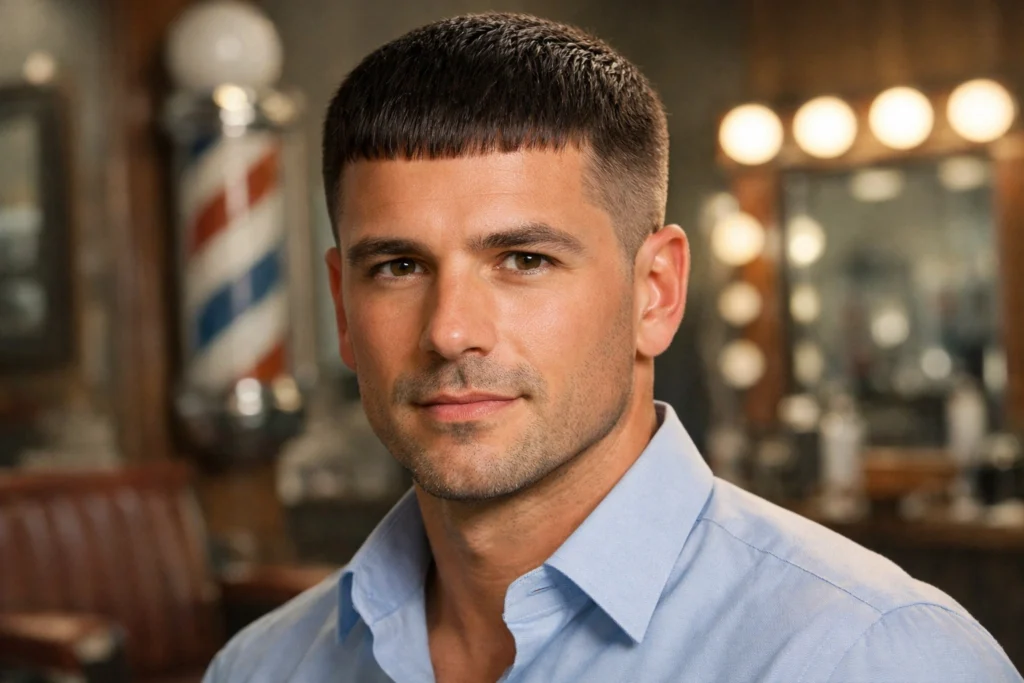
George Clooney brought the Caesar cut from ancient Rome directly into the 1990s consciousness, wearing it through his years on ER with the kind of clean, unfussy confidence that made the style feel both timeless and unmistakably of its moment. The Caesar cut features a short, horizontally cut fringe across the forehead combined with a uniform length through the rest of the top, with the sides and back slightly shorter through a taper or light fade. The defining characteristic is the horizontal fringe, which sits flat and forward, creating a clean and structured silhouette that is immediately recognizable.
The Caesar cut is one of the most practical and low-maintenance entries on this list. It requires minimal daily styling, holds its shape between cuts with ease, and suits a wide range of hair types and face shapes. Its contemporary version typically adds a low to mid fade on the sides for a cleaner, more modern contrast, and the fringe is often given slightly more texture than the original’s perfectly flat version. A light pomade or styling cream applied through the fringe gives it just enough definition without making it appear stiff or heavy. The Caesar cut is a strong choice for men who want a connection to the iconic 90s haircuts for men tradition without committing to significant length or daily styling effort.
Caesar Cut Versus Crew Cut
The Caesar cut’s defining difference from the crew cut is the forward-directed fringe. Where the crew cut keeps the top slightly longer without directing it forward, the Caesar actively pushes the front section toward the forehead, creating the characteristic horizontal line that gives the style its name.
The High Top Fade
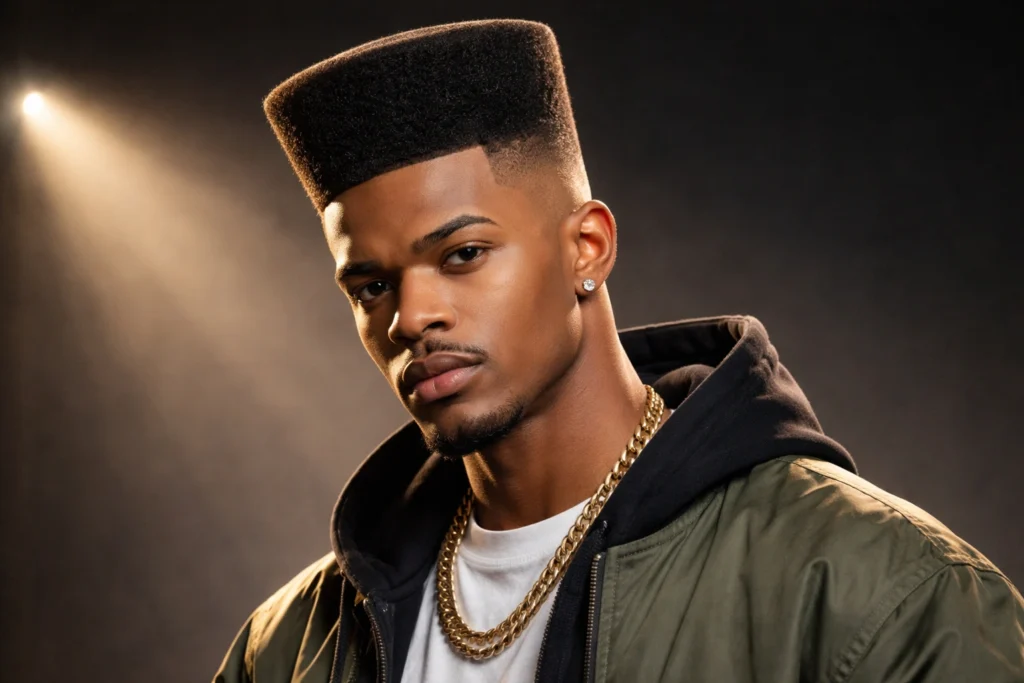
The high top fade was one of the most architecturally ambitious haircuts of the 1990s, and its cultural roots in hip-hop and Black American style gave it a significance that extended well beyond its visual impact. Will Smith made it mainstream through his role in The Fresh Prince of Bel-Air, Kid ‘n Play wore it as a defining badge of their artistic identity, and throughout the early decade the high top fade was a symbol of creativity, individuality, and cultural pride that no other haircut of the era could match.
The style features a dramatically extended flat top that rises vertically from the crown of the head, supported by closely faded or tapered sides that provide the contrast necessary for the top’s height to read clearly. The flat top itself is typically squared off or given a slight rounded shape, and the height can range from a modest lift to a dramatic architectural statement. Natural texture, particularly coarser or curly hair, works best for maintaining the height and definition of the flat top. A strong hold gel or setting product is applied evenly through the top and combed upward to build and maintain the shape. Regular visits to the barber are essential to keep the fade sharp and the top’s silhouette defined.
Modern Interpretation
Contemporary versions of the high top fade often incorporate a skin fade rather than a simple taper, and the top may be worn with slightly more texture and natural variation than the original’s perfectly uniform flat surface. A shape-up along the edges and hairline keeps the look precise and intentional.
The Grunge Long Hair
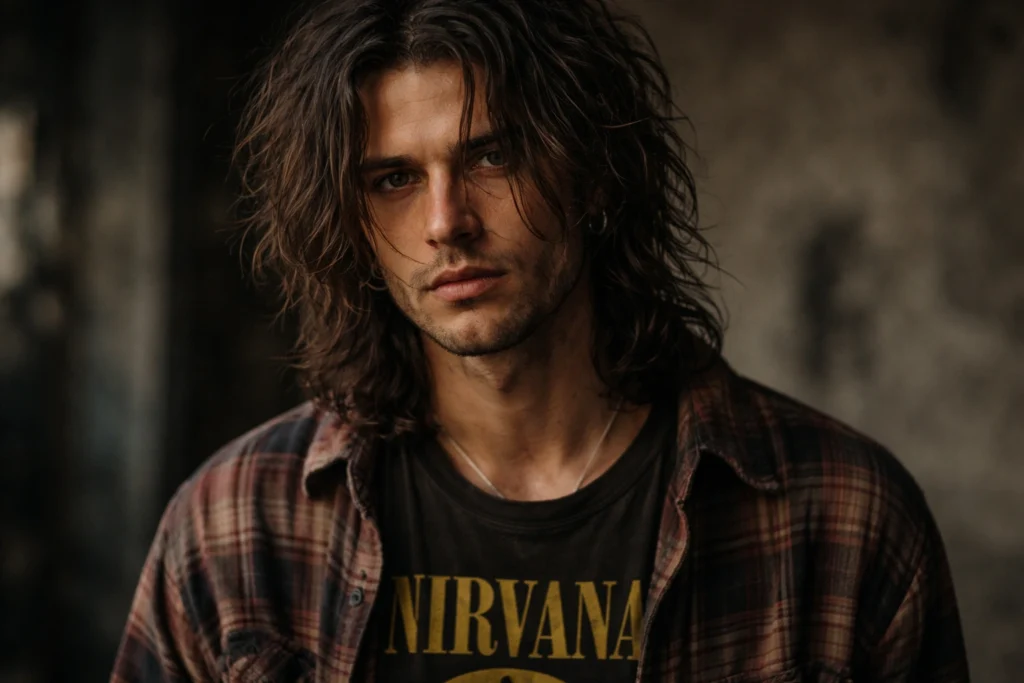
The grunge movement of the early 1990s produced one of the most deliberately anti-establishment hairstyles in the history of men’s grooming: long, layered, naturally textured hair worn with a studied disregard for formal styling conventions. Bands like Nirvana, Pearl Jam, and Soundgarden, and their frontmen Kurt Cobain and Eddie Vedder, made disheveled mid-length to shoulder-length hair the visual language of an entire generation’s rejection of the decade’s preceding excess and artificiality.
The grunge long hair is characterized by natural texture, minimal product intervention, and a willingness to let the hair do what it naturally does. It falls loosely around the face and over the ears, often with a rough center or side part that requires no particular precision. The lack of a defined fade or taper on the sides distinguishes it from more structured long hair styles, as the sides are allowed to grow out in a manner that blends naturally with the top. A light hold texturizing spray or a small amount of pomade applied through slightly damp hair is all the product this style needs. Modern versions often incorporate subtle layering from a skilled barber to remove excess weight and encourage movement without introducing the kind of structured shaping that would undermine the style’s essential character.
Grunge Hair Maintenance
Despite its appearance, grunge long hair benefits significantly from regular conditioning and occasional trims. A trim every six to eight weeks removes split ends and prevents the hair from losing its shape entirely, which is the difference between intentional grunge and simply unkempt hair.
The Bowl Cut
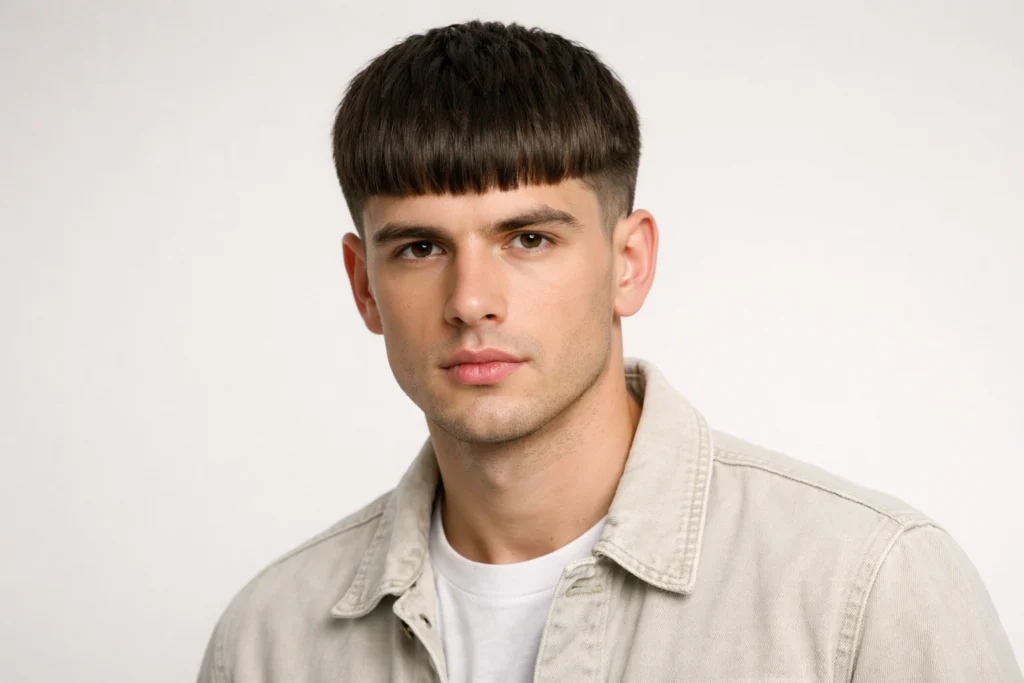
The bowl cut arrived in the 1990s as one of the decade’s most surprising style statements. Originally a purely utilitarian cut associated with childhood barbershop economics, it was adopted by rock bands, boy band members, and fashion-forward young men who recognized its subversive potential as a deliberately anti-conventional choice. Nick Carter of the Backstreet Boys wore a version of it. Alternative and grunge-adjacent musicians adopted it as a counterpoint to the long, disheveled styles of their peers. The bowl cut became a statement about not taking yourself too seriously.
The original bowl cut features a uniform length all the way around the head, with the hair cut to the same point on the sides and back and a straight fringe across the forehead, creating the appearance of a bowl placed over the head. The contemporary revival has applied modern barbering technique to the underlying concept: a low to mid fade on the sides replaces the blunt uniform cut, and the top is given texture and movement through scissor work rather than being left as a flat, uniform mass. The result is a haircut that retains the bowl cut’s recognizable silhouette and irreverent charm while reading as deliberate and contemporary rather than accidental or dated.
Fringe Texture for the Modern Bowl Cut
A straightened, flat fringe gives the bowl cut its original retro character. A slightly textured or ruffled fringe, achieved with a small amount of matte clay or texturizing product, gives the contemporary version a more relaxed and wearable quality. Which approach you choose depends on how much of a statement you want to make.
The Frosted Tips
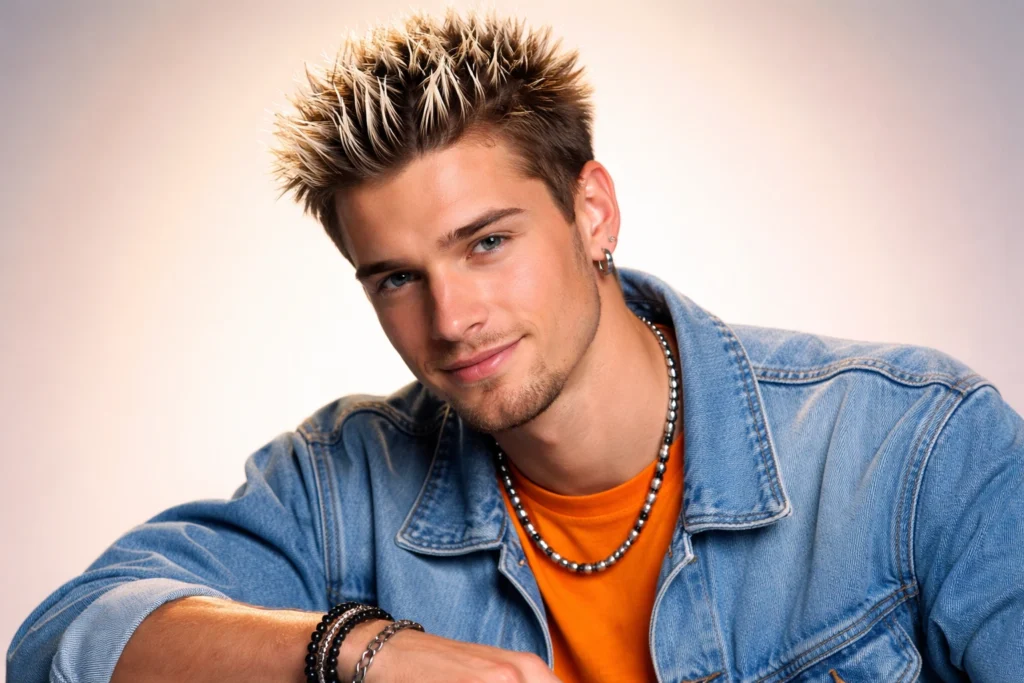
Frosted tips were the most visually distinctive and culturally specific of all the iconic 90s haircuts for men. They were everywhere: on boy band members, on teen heartthrobs, on pop stars and television actors who wanted to project youth, energy, and a degree of California cool without committing to a full bleach. The look involved bleaching only the ends of the hair, typically the top centimeter to two centimeters of each section, to create a platinum or silver contrast with the naturally darker roots and mid-lengths. Justin Timberlake wore them through the peak of his boy band years. Ryan Seacrest had them. An entire generation of young men sat in salon chairs with foil on their ends.
The appeal of frosted tips was their ability to add visual texture and brightness to any haircut without requiring full color commitment. Spiky hair styles particularly benefited from frosted tips, as the lightened ends made each spike read more distinctly against the darker mass of hair below. Contemporary grooming has produced a more refined version of the underlying concept: subtle balayage or natural-looking highlights that create the same brightness-at-the-tips effect without the stark, artificial contrast of the original bleached look. Men who want the spirit of frosted tips in a contemporary context should ask their colorist for a soft, graduated lightening through the ends rather than the blunt, uniform bleach of the 90s original.
Maintenance for Color-Treated Tips
Whether wearing classic frosted tips or their modern equivalent, color-treated hair requires a sulfate-free shampoo and a quality conditioner used consistently. Purple or blue toning products applied occasionally prevent the blonde from developing a yellow or brassy tone over time.
The Slicked Back Style
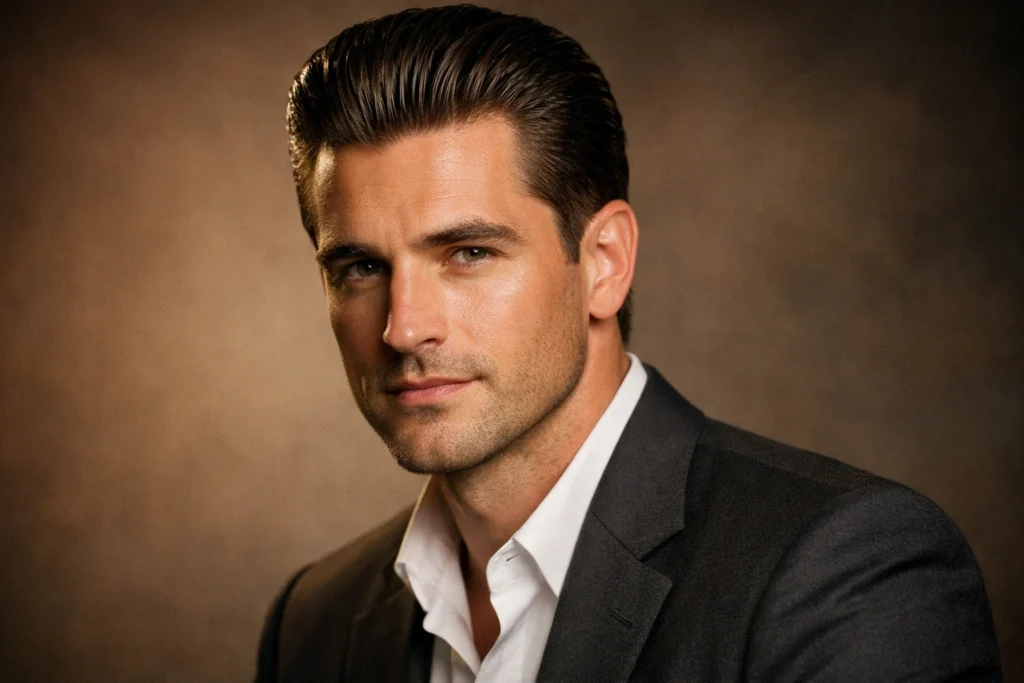
The slicked back hairstyle arrived in the 1990s from the 1950s via the 1980s, carried into the decade by Hollywood stars who recognized its ability to communicate sophistication, authority, and a controlled kind of masculinity that other styles of the era could not deliver. George Clooney, Brad Pitt, and other leading men of the decade wore variations of the slick back that shed the aggressive, petroleum-heavy styling of earlier iterations in favor of a softer, more natural take on the essential concept: hair swept cleanly back from the forehead with product that holds without stiffening.
The slicked back style requires medium to longer hair on top, typically two to four inches, and shorter sides that are either tapered, faded, or undercut to provide contrast with the longer swept-back top. A quality water-based pomade or styling cream applied through damp hair and combed or swept back with a wide-tooth comb delivers the look with the degree of sheen and hold it requires. The contemporary version favors a slightly softer, more textured interpretation than the high-shine, perfectly uniform version of the 90s original, and pairs naturally with a low fade or taper on the sides for a more modern barbering finish.
Pomade Selection
Water-based pomades are the practical choice for everyday wear: they provide the necessary hold and shine, wash out easily with water, and do not build up excessively over multiple applications. Oil-based pomades deliver a higher shine and stronger hold but require more effort to remove and are best reserved for special occasions.
The Spiky Hair Style
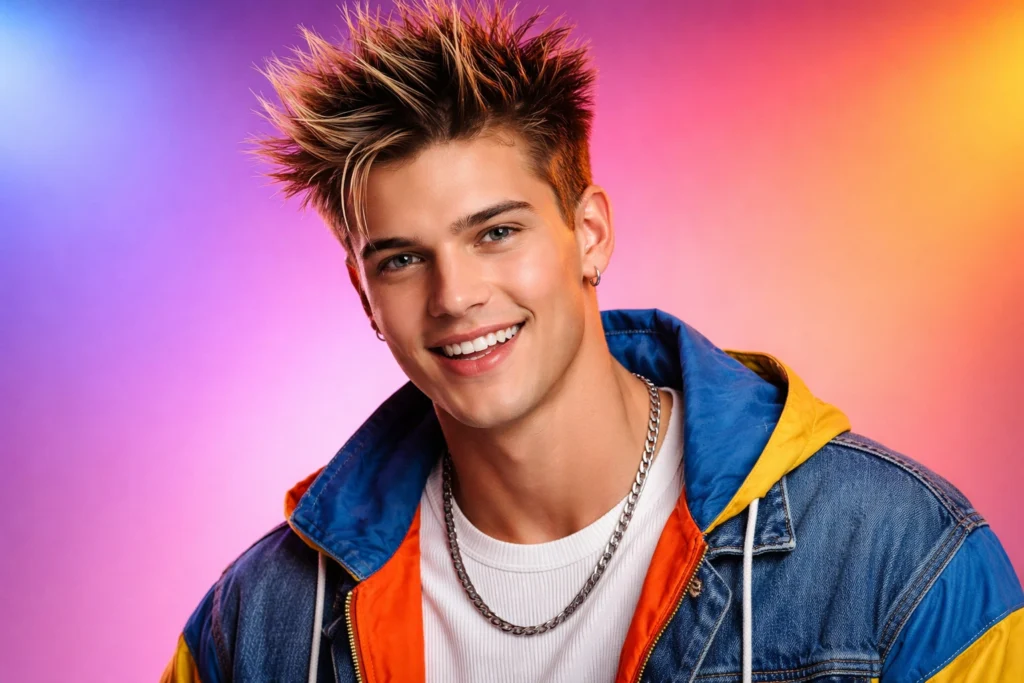
Spiky hair was the 90s equivalent of a style that did not try to be understated. It was loud, energetic, and deliberately three-dimensional, turning the top of the head into a landscape of upward-pointing individual sections that refused to lie flat. Boy bands relied on it heavily. Pop stars used it to project approachable youthfulness. Combined with frosted tips, which were almost always its companion, spiky hair became one of the most recognizable visual shorthand expressions of 90s male pop culture.
The spiky hair style is achieved by applying a strong hold gel or hard wax through either damp or dry hair and using fingers to push individual sections upward into points. The crown is typically the focus, with the front and sides either spiked similarly or left at a slightly lower height to create variation. The 90s original relied heavily on hard, crunchy gel that left the hair stiff and immovable; the contemporary version uses a matte clay or a softer wax that provides comparable hold with a more natural, touchable finish. Tapered sides rather than the blunt uniform cut of the original give the contemporary spiky style a cleaner, more modern barbered quality that maintains the essential energy of the look while avoiding its most dated characteristics.
Product Application Technique
Work the product through completely dry hair using your fingers, distributing it from the roots outward before gathering individual sections and pushing them upward. Styling on dry hair gives you more control over the shape and placement of each spike than styling on wet hair, which tends to clump sections together unpredictably.
The Mullet
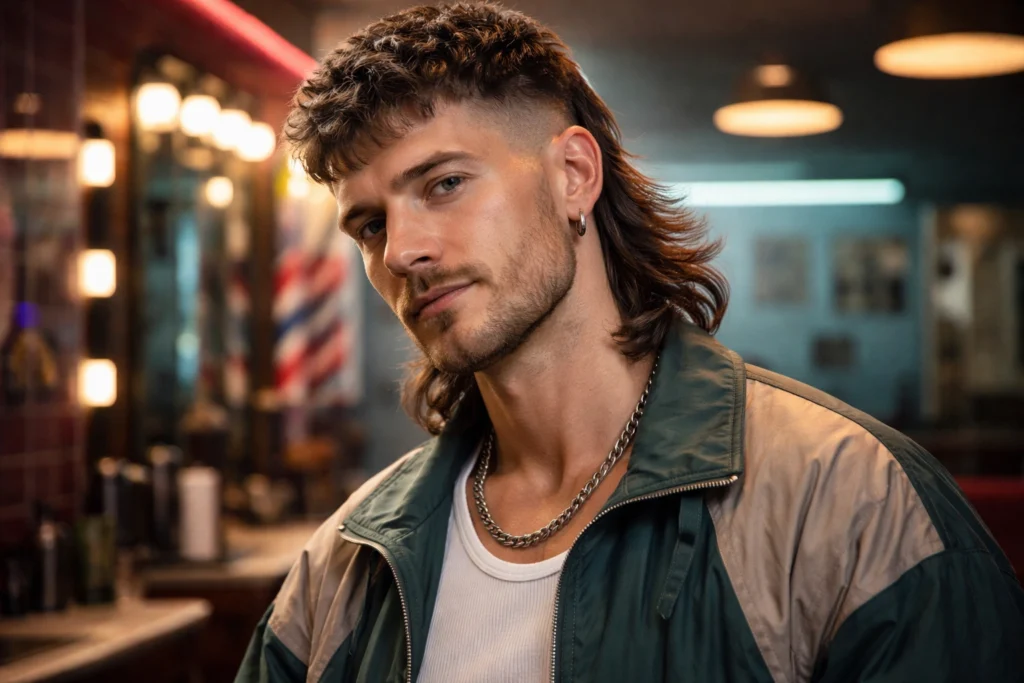
Few haircuts in history have been as simultaneously celebrated and ridiculed as the mullet. Short in the front and on the sides, long in the back, it was the signature hairstyle of a specific strain of 1990s masculine identity that combined practicality at the front with a sense of freedom at the back. The Beastie Boys immortalized it in song. Country musicians wore it as a badge of authenticity. Athletes, rock musicians, and ordinary men throughout the decade expressed a version of themselves through this most divisive of cuts.
The mullet’s current revival is one of the most significant grooming stories of recent years. Its contemporary interpretation has shed the most extreme version of the original’s proportions in favor of a more graduated transition from short front sections to longer back sections, often paired with a drop fade on the sides and subtle layering through the back that adds movement and prevents the longer section from appearing flat or shapeless. Textured tops and curtain fringes are frequently incorporated into modern mullet interpretations, creating a hybrid that references the original clearly while functioning as a genuinely contemporary style. For men willing to commit to an unconventional silhouette, the modern mullet is one of the most expressive and conversation-starting choices available at any barbershop today.
Length Proportions
The most wearable contemporary mullet maintains a moderate differential between the front and back sections rather than the dramatic contrast of the original. A top that sits at two to three inches combined with a back that extends to the collar or slightly below reads as confident and intentional without the period-costume quality that more extreme versions can produce.
The Buzz Cut
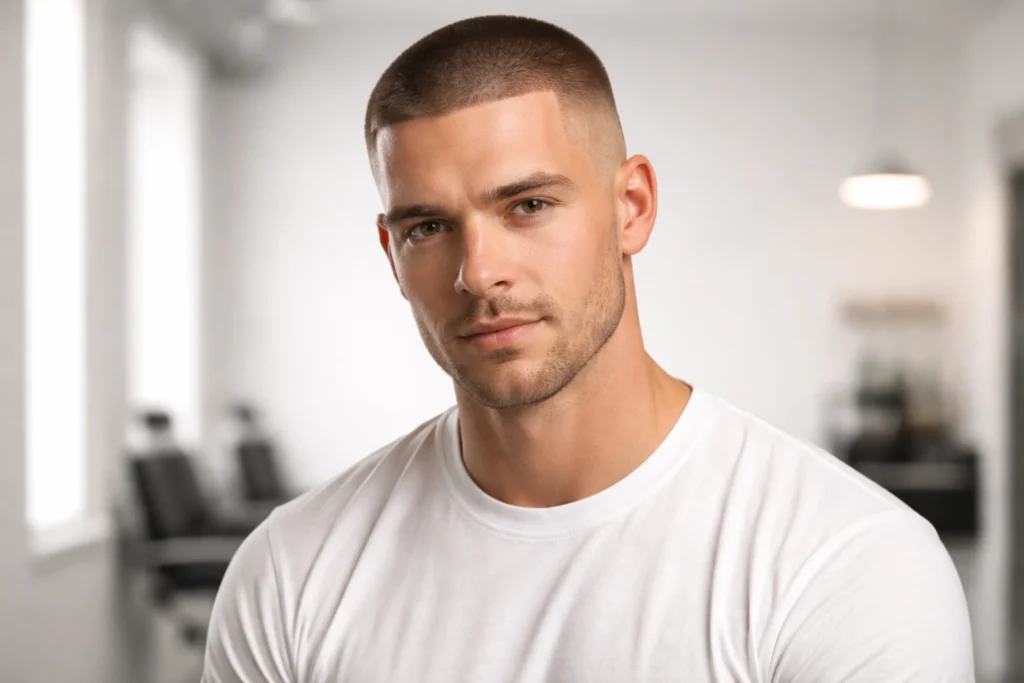
The buzz cut was the great democratic haircut of the 1990s. It required no styling, cost very little to maintain, and suited virtually every face shape and hair type. Its appeal in the decade spanned the entire cultural spectrum: athletes wore it for practicality, musicians adopted it as a statement of directness and anti-fashion sentiment, and Hollywood actors used it to signal a particular kind of no-nonsense masculinity. It was, in its own way, as deliberate a style statement as the most elaborate haircut of the era.
The buzz cut is defined by its uniformly short length across the entire head, achieved using electric clippers with a guard set to a specified length. The classic 90s version maintained approximately the same length all over, distinguishing it from the faded or tapered variations that have become the dominant contemporary interpretation. Modern buzz cuts most commonly incorporate a subtle fade or taper around the hairline, temples, and neckline that refines the silhouette without altering the essential character of the style. A shape-up along the hairline edges using a precision trimmer gives the contemporary buzz cut its sharp, intentional quality. Skin care becomes particularly relevant with a buzz cut, as the scalp and face are more exposed and the quality of the skin directly affects the overall impression of the style.
Buzz Cut Lengths
Clipper guards numbered from zero to four are used most commonly for buzz cuts, producing lengths from skin-close at zero to approximately thirteen millimeters at four. The most flattering range for most men falls between a number two and a number three, which leaves enough hair to show texture and color while maintaining the clean, low-maintenance quality the style is known for.
The Flat Top
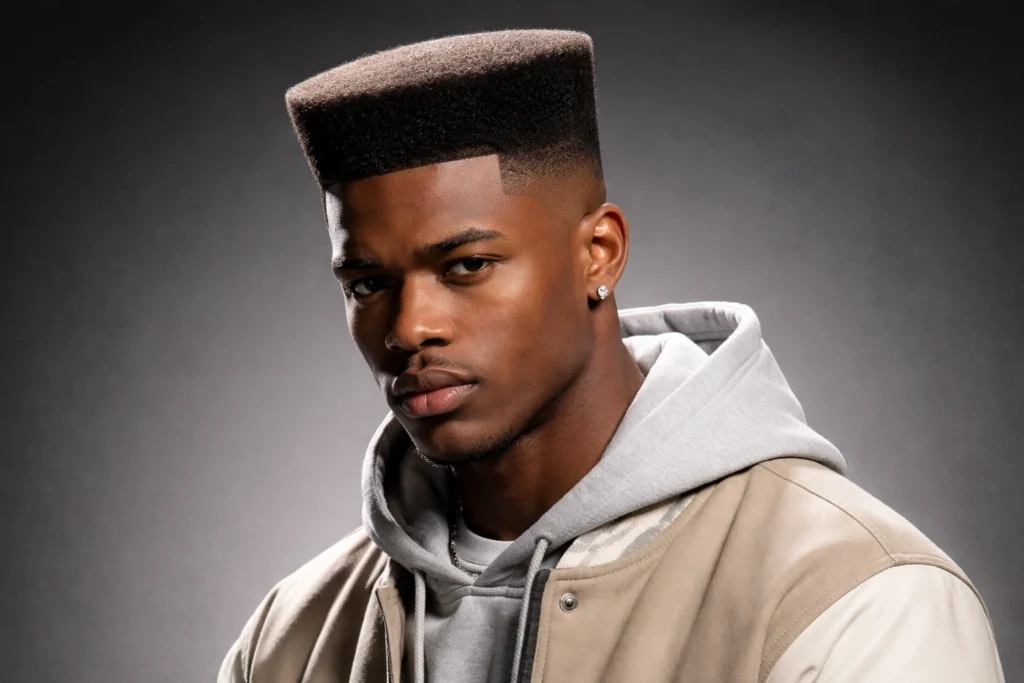
The flat top was an architectural achievement in hair, requiring significant skill from the barber who executed it and a commitment to maintenance from the man who wore it. Its silhouette was unmistakable: perfectly flat across the crown of the head, creating a horizontal plane that sat level above closely cropped sides and back. The high-top fade was a variation on this basic concept that added dramatic height, but the flat top proper was about precision and cleanliness rather than height alone.
The flat top carried particularly strong associations with hip-hop culture, military aesthetics, and the kind of disciplined personal presentation that communicated self-respect through grooming. Grace Jones and hip-hop artists had explored the concept in the 1980s, and the 90s refined and popularized it across a broader cultural range. Contemporary barbering has maintained the flat top as a legitimate and available option for men who want a strong, geometric haircut with direct roots in 90s grooming culture. A barber with experience in this style will use clippers with no guard for the sides and a flat-top comb with clippers run horizontally across the top to achieve the characteristic level surface. Regular trims every two to three weeks are essential to keep the flat geometry of the top from losing its precision.
Flat Top Versus High Top Fade
The flat top maintains a moderate height above the crown and emphasizes the geometric precision of the flat surface. The high top fade prioritizes height over precision and typically features more volume and a less rigorously level top surface. Both are legitimate expressions of the 90s flat-top tradition; which suits you better depends on how much drama you want the haircut to carry.
Conclusion
The 20 iconic 90s haircuts for men covered in this guide represent one of the most diverse and culturally rich decades in the history of men’s grooming. From the heartthrob elegance of the curtain haircut to the architectural boldness of the high top fade and flat top, from the deliberate anti-fashion of grunge long hair to the pop-polished energy of frosted tips and spiky styles, the 1990s produced a range of expressions that collectively covered virtually every dimension of masculine identity.
What makes these cuts worth revisiting today is not simply their nostalgic appeal. It is the quality of their underlying concepts. The curtain haircut works because it is genuinely flattering. The Caesar cut works because it is practical and clean. The slicked back style works because it communicates controlled sophistication that never goes out of fashion. These styles earned their iconic status through real effectiveness, and that effectiveness has not diminished with time. Bring any one of them to your barber with a clear description of how you want it interpreted for today, and you will leave with a haircut that turns heads for exactly the right reasons.
You may also like this post: 20 Super Cool Japanese-Inspired Hairstyles for Men
Frequently Asked Questions
Which iconic 90s haircuts for men are easiest to maintain today?
The Caesar cut, buzz cut, and slicked back style are among the lowest maintenance options from the 90s era. The Caesar cut holds its shape naturally between trims, the buzz cut requires no daily styling whatsoever, and the slicked back style needs only a quick comb through with product each morning to look intentional and sharp.
Are frosted tips appropriate for professional environments in 2025?
The classic heavily bleached frosted tips of the 90s tend to read as a strong style statement that may not suit all professional environments. The contemporary version, which uses subtle balayage or graduated highlights to achieve a similar brightness-at-the-tips effect, is considerably more versatile and workplace-appropriate while still referencing the spirit of the original.
What hair type is best suited to the curtain haircut?
The curtain haircut works best on straight to wavy hair of medium length, typically three to five inches on top. Men with naturally straight hair find the curtains fall cleanly and frame the face well with minimal product. Those with a slight wave find the style gains additional movement and dimension. Very curly hair tends not to produce the characteristic falling curtain effect without significant straightening.
How long does it take to grow enough hair for the iconic 90s curtain or grunge long hair styles?
Most men will need four to eight months of growth from a short cut to achieve the length required for a curtain haircut, and six to twelve months for a genuine grunge long hair style. During the growing-out phase, ask your barber to trim only the ends and shape the sides at each visit to keep the style looking intentional rather than simply grown out without direction.
Can the mullet be worn in professional settings today?
Modern mullet interpretations, particularly shorter versions with a more graduated front-to-back length differential, are increasingly accepted in creative industries, media, fashion, and other environments that value individuality in personal presentation. More conservative professional environments such as finance, law, and corporate business settings generally still favor more conventional cuts. Assess the culture of your specific workplace before committing to a mullet, regardless of how refined its contemporary interpretation may be.
1 Comment